Smiirl
The customer app of a connected device, built from zero to one.
- Role
- Frontend engineer and product owner
- Period
- 2017 – 2019
- Sector
- Connected devices, Paris
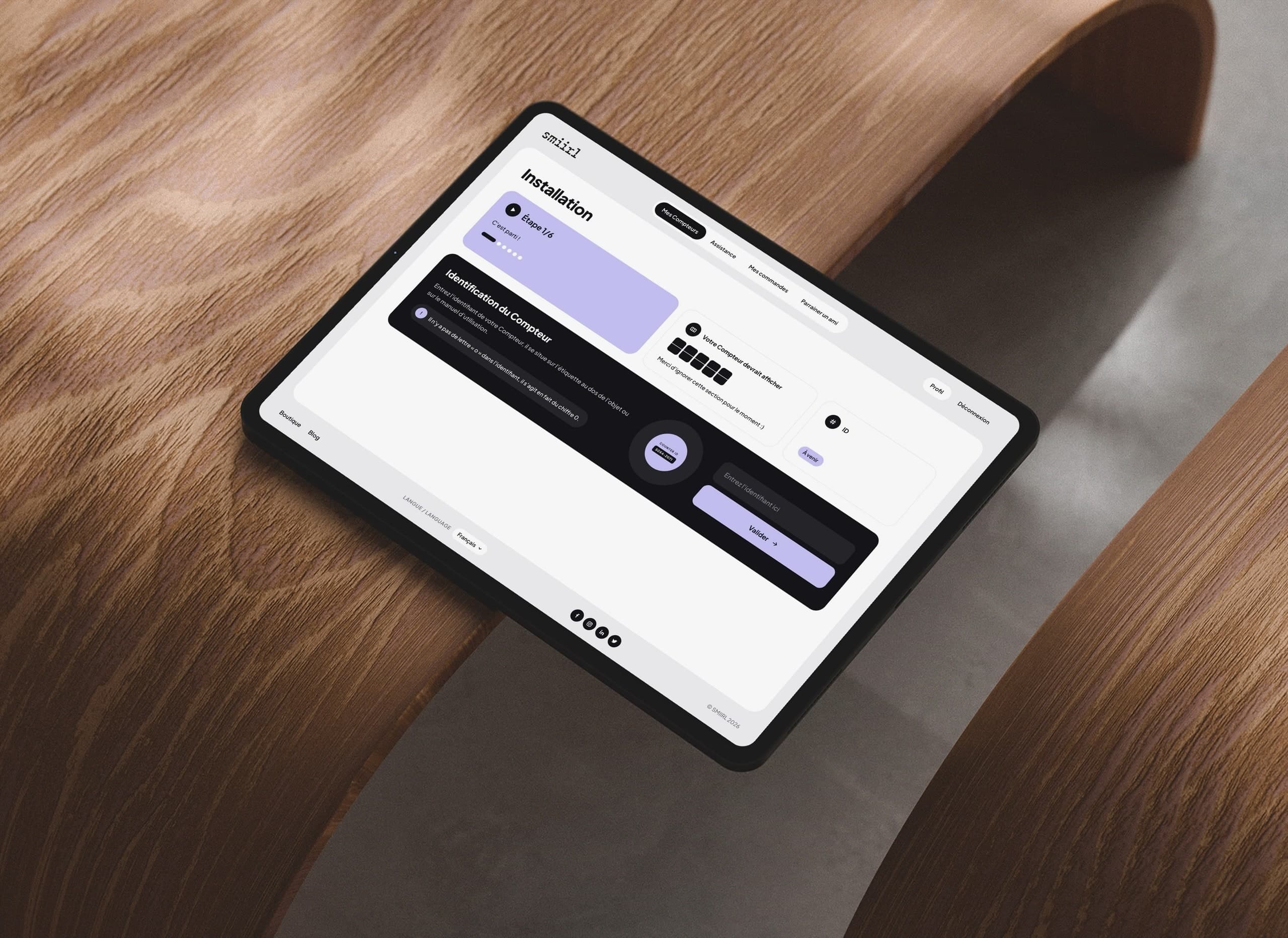
- 01Setup tickets cut in halfAt least 50% fewer setup-related support tickets in the first months after launch
- 02Setup moved into a single appConnection, account, orders and help in one place, in five languages
- 03A product process for the appSprints, ticketing and testing, set up as its product owner
Smiirl makes connected counters: physical displays that show a live number, such as a shop's Instagram followers.
Before a counter could display anything, the customer had to connect it to the internet. That meant joining a wifi network broadcast by the device and using a configuration page hosted on it. Most customers were not technical, and many of them contacted support at this step.
I joined Smiirl as a junior frontend engineer. Over two years, I designed and built the customer app that replaced this procedure, and acted as its product owner.
The goal was for customers to set up their counter without contacting support.
- Team
- 5 — me (product owner, lead developer and designer), a second developer, the product manager, the CTO on QA, a marketer on translations and content
- Stack
- React · Node.js · Symfony
- Tooling
- Hotjar · Scrum
Three problems to solve before customers could set up a counter on their own.
- Problem 01
The counter could only be configured through a page hosted on the device itself, which customers reached by switching to the device's wifi.
SolutionAn API between the app and the counter, so the setup could be done from Smiirl's site instead of from inside the device.
- Problem 02
During setup, customers had no way to see what the device was doing or whether a step had worked.
SolutionAn interface that shows a representation of the counter at each step, matching what the real device displays.
- Problem 03
Customers were spread across 87 countries.
SolutionThe app in five languages, with a help center built alongside it.
How we built it, step by step.
Understanding the problem
Support tickets already showed where customers got stuck, so the problem itself was clear from the start.
To decide how to solve it, we bought competing connected devices and studied how each one handled its connection process.
Setup tickets cut in half.
In the first months after launch, setup-related support tickets dropped by at least 50%.
Setup moved into a single app.
Customers connect their counter, manage their account, follow their orders and find help in one place, in five languages.
A product process for the app.
The app was one of Smiirl's first products run with Scrum and a dedicated product owner.
Next case study
Evergon Labs — 2024The MVP of a tokenization platform, built for two kinds of customers.